Singapore is not a Sunday city. On the day most Western cities go quiet, we go somewhere between "moderately busy" and "actually closed." The office districts empty. The heartlands rearrange themselves around family lunches and grandparent visits. The shopping malls fill with teenagers pretending to buy things, and the coffee shops fill with old men who have already read the newspaper twice.
There is one exception. On Sunday afternoons, Little India is louder, fuller, and more alive than it is on any other day of the week. I did not know this for the first fifteen years I lived in Singapore. I only know it now because of a particular Sunday in August 2023, when I got off the MRT at the wrong stop and decided, having got off, not to correct my mistake.
Why Sunday
Sunday afternoons on Serangoon Road are the day off for a large portion of the migrant workers in Singapore. Men who spend six days a week on construction sites and in dormitories in the outer neighbourhoods come, on their one day of freedom, to this stretch of Little India — to eat food they know, to speak languages they grew up in, to see people whose names they have not had to explain since 6am on Monday. The neighbourhood does not belong to them. But on Sunday afternoons it also, in a certain way, does.
I say this without romance and without complication. I say it because it is the specific texture of the afternoon. The men outside the money transfer shops. The queues at the tea stalls. The recorded Tamil-language music playing from three different shopfronts. The specific smell of banana leaf rice from the corner restaurant I did not eat at that day but should have.
What I did instead
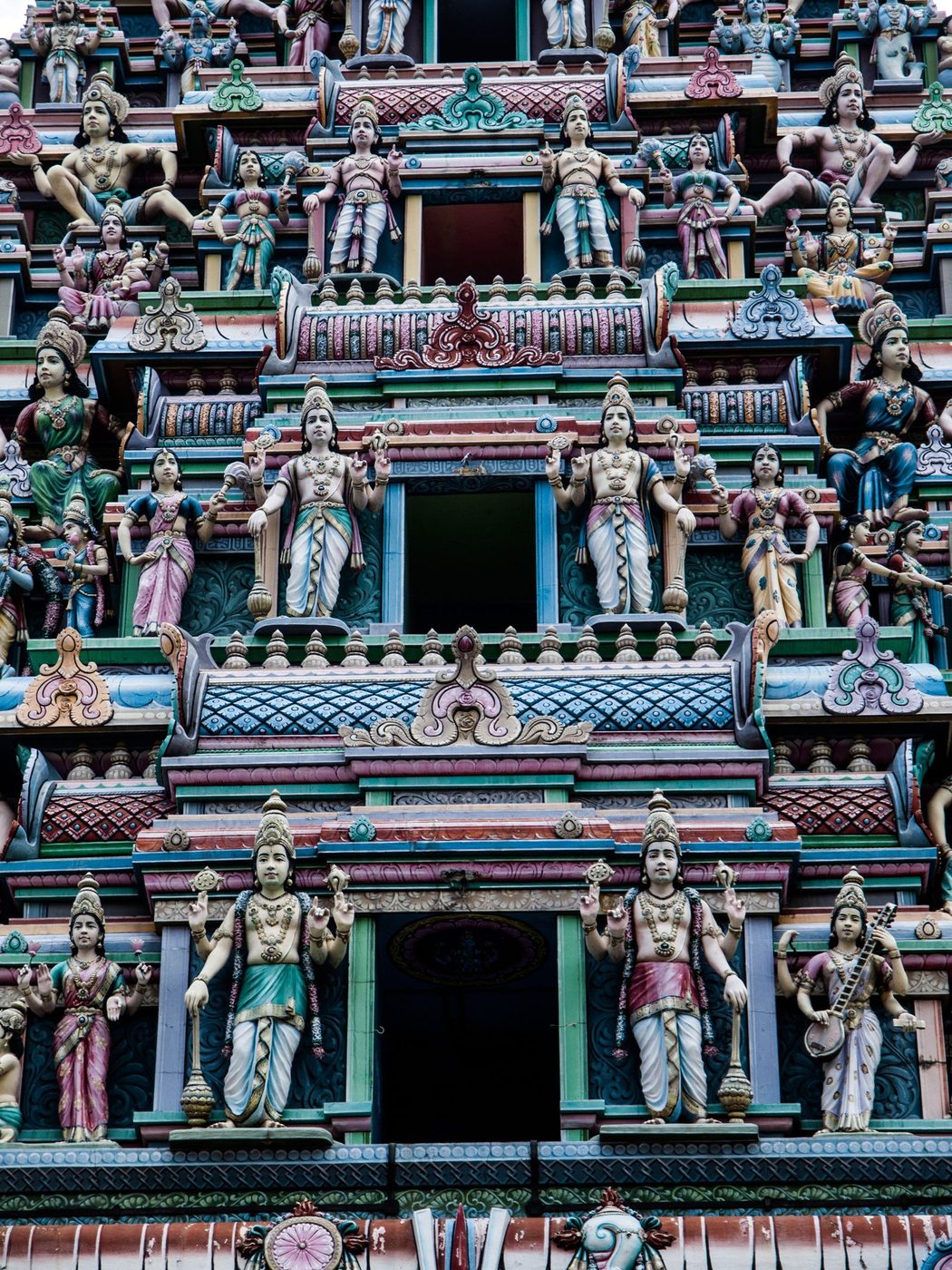
I walked. From Farrer Park MRT I went south on Race Course Road, then east on Buffalo Road, then up Serangoon to the temple. The temple is Sri Veeramakaliamman, one of the oldest Hindu temples in Singapore, and its gopuram is one of the more photographed pieces of architecture on the island. I have walked past it dozens of times. This was, embarrassingly, the first time I stopped.
I did not go inside. This felt, without my being able to justify it, like the correct thing to do. I stood for perhaps ten minutes on the pavement opposite the entrance and I looked, carefully, at the figures on the gopuram. They are painted every few years. On the day I visited, the paint was fresh — the blues were still brilliant, the pinks were still pink. Somebody had recently, and with great care, restored them.
"There is a version of Singapore that I do not live in and that does not belong to me. It exists. It is happy. It is loud. It is on Serangoon Road on Sunday afternoons."
The lassi
After the temple I stopped at a small restaurant off Cuff Road for a mango lassi. It cost $3.20. The man at the counter took my order, said nothing, and produced the drink two minutes later. Behind me a group of four men were speaking a language I could not identify. They were laughing about something on one of their phones. When I got up to leave, the oldest of the four caught my eye, smiled slightly, and did the small chin-lift that all Singaporeans, of every background, seem to know.
I did the same back to him. Neither of us said anything. It was a very Singapore moment, and it was also — I want to be clear — a moment that happens in a place I do not live in on a day I do not usually see. The Singapore I know is quiet on Sundays. The Singapore he was showing me is not.
Both are real. Both are here. On this small island there are, on any given afternoon, several dozen different cities operating in parallel, and most of them, for most residents, are invisible. Getting off at the wrong stop is one way of remembering.
I recommend getting off at the wrong stop occasionally. I recommend, especially, doing it on a Sunday.